


The Disconnect Between the Race Surface and the Public Transportation Surface: Why Volunteer Fire Departments Get It Wrong on Race Day.
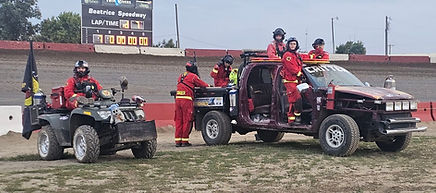
Car accidents are not an uncommon thing for any fire department, paid or volunteer. In most rural areas, it’s probably the most co
mmon call a department will run, second only to medical calls. And it’s safe to say a large majority of these departments are more than proficient at dealing with a highway accident.
Trucks roll up. Extrication tools get staged. A water line is pulled for any flare-ups. Cribbing goes into stabilizing the vehicle or vehicles. Crews start patient assessment, make a quick and coordinated plan of attack, and go. This all happens within seconds of arrival. It’s a dance. It’s a symphony. And when it’s done right, it’s beautiful.
So… why do those same departments struggle on the track?
Yes, I’m generalizing. Some departments do a solid job at the raceway. But if we’re being honest, a lot of volunteer fire departments covering standby on race night are ill-equipped—not with tools, but with knowledge.
They’re trying to apply what works on the public roadway to a racing surface that plays by completely different rules. Different vehicle construction, different speeds, different fire behavior, different egress options, and a completely different risk tolerance from the people strapped into those cars. That disconnect is exactly where things start to go wrong on race day.
The race surface is not just a highway in a circle
On paper, it’s easy to shrug and say, “It’s still cars, still crashes, still fire. How different can it be?” That mindset is exactly where the problems start.
A public roadway is designed to move traffic safely from Point A to Point B. A race surface is designed to push the limits of speed, grip, and risk. The physics, the layout, and the priorities are all different—and if you treat them the same, you will make bad decisions on race day.
On the highway, your world is usually linear. You’re dealing with lanes, shoulders, ditches, and maybe a median. Access is mostly predictable: you come in from the road, maybe shut it down, maybe divert traffic, and build your work zone around that. You can usually create space between you and the hazard with cones, apparatus placement, and law enforcement control.
On the race surface, you are stepping into the hazard zone by definition. The “traffic” you’re worried about isn’t distracted drivers at 55 mph; it’s race cars at 80–120 mph, running inches apart, often with limited visibility, on a surface that’s constantly changing with rubber, moisture, and debris. Your safe zones, escape routes, and sight lines are completely different from what you’re used to on the highway.
Track layout alone changes your job. Tight corners, blind exits, banking, walls, and catch fences all dictate where you can and cannot safely stand, stage, or move. The same turn that looks wide open from the grandstands can be a funnel of energy when a car loses it and rides the wall. Access points are limited to gates, openings in the wall, and crossover roads that were designed for race operations—not for you to park a 30,000‑pound rescue truck wherever you feel like it.
Then there’s the surface itself. A dirt track that’s slick on entry and tacky on exit is a completely different animal than a dry asphalt highway. You’re running, carrying tools, and working in mud, marbles, and ruts that can take your feet out from under you if you move like you’re on pavement. The groove changes throughout the night, which means the most dangerous part of the track for you to stand in is also the part the drivers are aiming for every single lap.
On the road, you can usually take the time to build your scene: block with apparatus, set cones, establish upstream warning, and control the environment before you commit people. On the race surface, you don’t get that luxury. You’re working inside a machine that doesn’t stop just because you showed up with a vest and a radio. Yellow flags, red flags, race control, and driver expectations all dictate how much time you really have and how much exposure you’re accepting every time you step on the track.
When a department walks into that environment with a “highway playbook,” they’re already behind. They park where they feel comfortable instead of where it’s actually safe. They walk the wrong lines on the track. They turn their backs to live traffic. They underestimate how fast “one more lap” can turn into “they’re wrecking in turn three and you’re standing in it.”
The race surface is not just a highway in a circle. It’s its own ecosystem with its own rules. Until departments start treating it that way—learning the lines, the access points, the blind spots, and the flow of a race night—they will keep making preventable mistakes, even with the best intentions and the best tools on the truck.
Race cars are not passenger vehicles
The next big trap for well-meaning departments is assuming the thing that just hit the wall is basically a passenger car with stickers.
It isn’t.
Race cars are purpose-built machines designed to go fast, take hits, and keep the driver alive inside a very specific safety envelope. When you walk up to one with a “minivan on the interstate” mindset, you will miss critical hazards, waste time, and—worst case—turn a survivable crash into a life‑altering injury.
On the street, most of what you see is predictable: unibody construction, factory doors, standard glass, airbags, three‑point seatbelts, maybe some aftermarket junk bolted on. Your extrication plan is built around that consistency. You know where the posts are, where the fuel tank probably sits, how the seatbelts work, and how the car is supposed to come apart.
On the track, all of that goes out the window.
Race cars are cages first and “cars” second. The body panels you see—sheet metal, fiberglass, plastic—are often little more than decoration and aerodynamics. The real structure is the chassis and roll cage underneath: tubing, welds, gussets, and bracing that are absolutely not interested in cooperating with your standard “pop a door, take a roof” game plan.
Doors might not open at all. Windows might not exist. The driver may be climbing in and out through the window opening, over bars, around a steering wheel that doesn’t look anything like what you see on the street. There are nets, head‑and‑neck restraints, containment seats, five‑point or seven‑point harnesses, fuel cells, shutoff switches, and sometimes batteries and fuel systems in places that would make an auto manufacturer’s lawyer pass out.
Fuel and fire behavior change too. You might be dealing with gasoline, E85, methanol, or other blends. Methanol fires, for example, don’t look or behave like the gasoline fires you’ve trained on in the parking lot. The plastics, composites, and rubber compounds on a race car burn differently, produce different smoke, and create different heat signatures than what you’re used to on a stock sedan.
Restraint systems are another huge difference. On the highway, you’re used to three‑point belts and maybe a child seat. On the track, the driver is bolted into the car. Harnesses are tight. Head‑and‑neck devices are locked in. Containment seats wrap around the torso and head. All of that is great for surviving a 70‑mph impact into a concrete wall—but it means you cannot just unbuckle whatever you see and start yanking.
If you don’t understand how those systems work, you can easily:
Cut the wrong strap and make it harder to get the driver out.
Twist or torque the driver’s spine while they’re still locked into the seat.
Fight the equipment instead of using it to your advantage.
The point isn’t that race cars are “scarier” than passenger vehicles. The point is that they are different. Different construction, different safety systems, different fuel, different fire behavior, different egress paths. If your only plan is “treat it like a car wreck,” you’re gambling with the one thing that matters most: the driver’s ability to walk away from something they should have survived.
Departments that do well on race night are the ones that respect that difference. They learn how the cars are built at their local track. They know where the kill switches are. They know how the harnesses release. They know what fuel is being run and what that means for their extinguishment plan. They train not just on “car vs wall,” but on “race car vs wall, upside down, with a conscious driver who can’t get out and is probably pissed.”
The operational mindset shift: from “secure the scene” to “protect the driver in a live environment.”
This is where the wheels really come off for a lot of well‑intentioned departments.
On the street, the mindset is drilled in from day one: secure the scene, control traffic, establish command, make it safe, then go to work. That’s not wrong. On a public roadway, it’s exactly what you should be doing.
But race night is not a highway call. You are not in charge of the environment. You are stepping into someone else’s machine while it’s still moving, and if you try to run your highway playbook in that environment, you will be slow, you will be in the wrong place, and you will expose your people and the driver to unnecessary risk.
On the highway, you can shut it down. You can block with apparatus, set cones and flares, get law enforcement upstream, and build a bubble of safety around your work. Most of the time, nothing else happens on that road until you say it does.
On the race surface, the show doesn’t stop just because you showed up with turnout gear. Even under a yellow or red flag, there’s momentum, pressure, and expectation. Race control is trying to keep the program moving. Drivers are frustrated, hot, and strapped into cars that are not meant to sit still for long. Promoters are watching the clock, the crowd, and the purse. You are one piece in a much bigger moving puzzle.
That means your mindset has to shift from “we own the scene” to “we protect the driver inside a live environment.”
Time expectations are completely different. On the street, getting a crew to the patient in a couple of minutes is acceptable. On the track, if you’re not moving within seconds, everyone notices—and more importantly, the driver feels it. A 5–10 second response from the time the car stops moving to the time a gloved hand is on the car is the standard you should be chasing, not the exception.
To hit that, you can’t be figuring it out on the fly. You need pre‑plans, assignments, and muscle memory that are specific to that track. Who goes to the car? Who watches upstream traffic? Who brings what tools? Where do you stage? How do you enter and exit the surface? If those answers are “we’ll just see when we get there,” you’re already behind.
The way you think about “scene safety” also has to evolve. On the highway, scene safety often means creating distance and barriers between you and moving vehicles. On the track, you don’t have that luxury. You are going to be close to the groove. You are going to be near walls, blind spots, and runoff areas. Your safety comes from understanding the flow of the race, the line the drivers run, where they lose cars, and how race control manages cautions—not from a cone line and a big truck parked sideways.
You also have to get comfortable with the idea that you’re working under someone else’s flag. Race control, not the incident commander in a vest, dictates when cars are rolling, when they’re stopped, and when they’re coming back to green. If you don’t have a tight communication loop with race control—clear signals, clear language, clear authority—you will either rush into a hot track or stand there waiting while a driver sits in a bad position longer than they should.
Departments that struggle on race night usually aren’t lacking courage. They’re lacking a framework. The crews that excel are the ones that embrace the mindset shift, learn the race program, build relationships with race control and officials, walk the track, identify danger zones, and rehearse how they’ll move when—not if—something goes wrong.
So what can departments actually do about it?
Most small‑town departments don’t have a blank check, a full‑time training division, or a fleet of purpose‑built track trucks. They’ve got hand‑me‑down rigs, limited budgets, and a roster full of people who already work a full‑time job before they ever pull on a helmet.
The good news is you don’t need to become a professional motorsports safety team overnight. You just need to stop pretending race night is “just another highway call” and start building a plan that respects how different this environment really is.
That starts with a few concrete steps.
Walk the track before you work the track
If your first real look at the racing surface is from the back of an engine with the lights on, you’re
already behind.
Schedule a time—daylight, no cars on track—to walk the facility with race control and track officials. You’re building a mental map:
Access points in and out of the surface
Blind spots from the flagstand and from your staging areas
Where cars typically lose it and hit
Safe vs “never stand here” zones
Fire extinguishers, fuel storage, and emergency power shutoffs
Put this on a simple track diagram and make it part of your pre‑incident plan.
Learn the cars you’re actually protecting
Pick one or two classes that run at your track and do a hands‑on session in the off‑season or early in the year.
Get a car in the shop or pits and identify:
Cage structure
Fuel cell and battery location
Master kill switch
Harness and window net setup
Practice getting in and out the way the driver does. The goal isn’t to turn every firefighter into a crew chief; it’s to make sure the car isn’t a mystery when it’s on its side against the wall.
Build a race‑night playbook
If your only race‑night strategy is “we’ll be there with a truck,” you don’t have a strategy.
You need a simple, written playbook that answers:
Where do we stage during green‑flag racing?
Who moves on the first call to the track, and with what tools?
Who watches oncoming traffic and protects the crew at the car?
What’s our default plan for a car in the wall, a rollover, or visible fire?
How do we communicate with race control, and who can say “we’re not clear yet”?
One or two pages of clear expectations will put you miles ahead of the “we’ll figure it out when it happens” approach.
Train for the environment you’re actually in
Most departments do extrication drills in a parking lot with junk cars and plenty of space. That’s fine—for highway work.
For race night, you need at least a couple of reps a year that look and feel like the real thing:
Short response distances
Limited access points
Time pressure: aiming for hands‑on‑the‑car in under 10 seconds
Working in gear on a slick or uneven surface
Communication with a “race control” role that can throw yellow or red
If you can do this on the actual track in the off‑season, perfect. If not, simulate as much as you can with cones, barriers, and clear “groove” rules.
Bring in motorsports‑specific training when you can
There’s a limit to how much you can learn from YouTube and good intentions. At some point, if your department is going to keep covering race nights, it’s worth investing in people who live in this world full‑time—whether that’s a conference, a class, or partnering with a dedicated track safety team for joint drills and after‑action reviews.
You don’t have to reinvent the wheel. You just have to admit the race surface is not the highway, race cars are not passenger vehicles, and race night is not “just another standby.”
Once you accept that, you can start doing the work that actually protects the people who strap in and trust you to be ready when it all goes wrong.

Comments